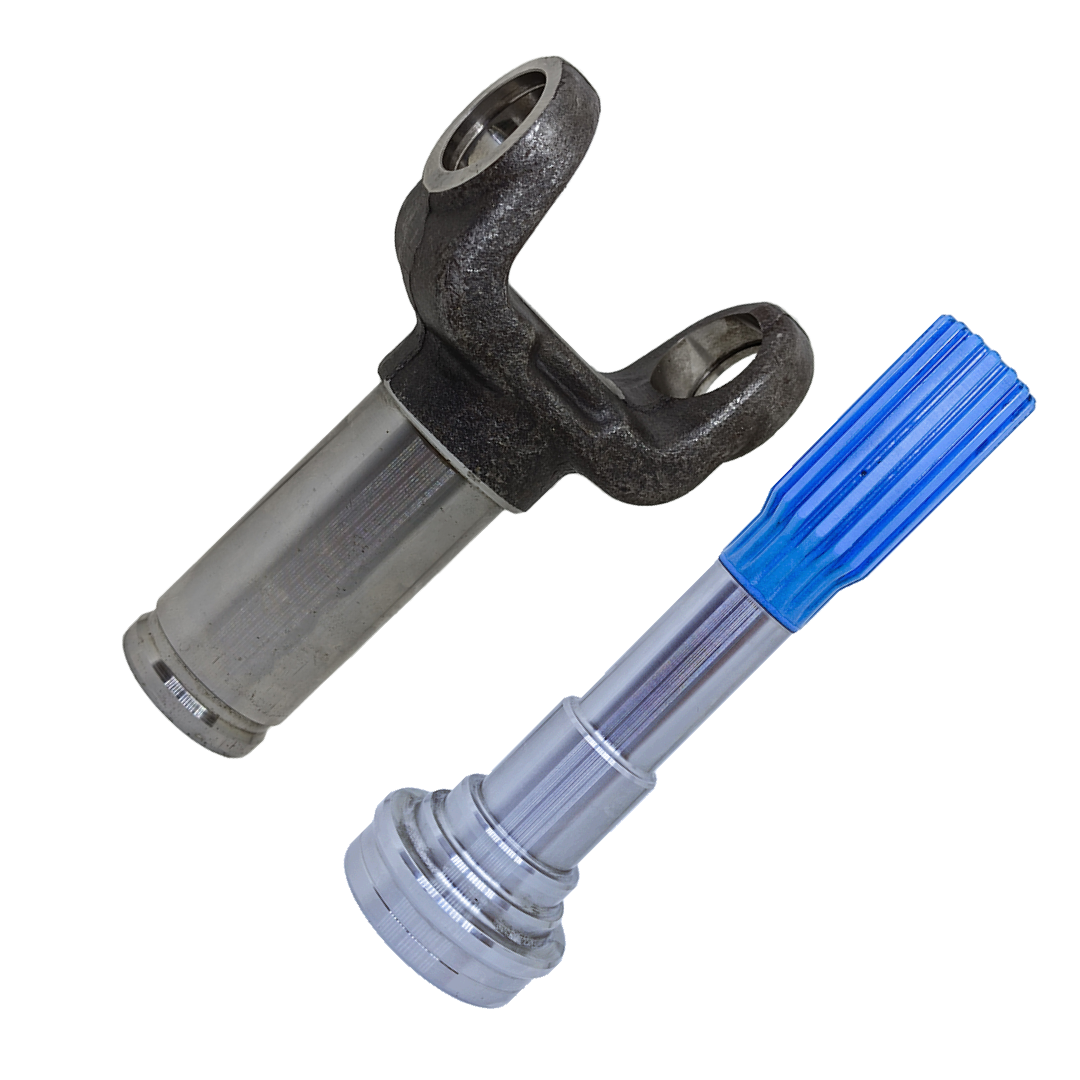
A buyer in Chennai sends us an enquiry for a "rear drive shaft" for a tipper. What arrives in the next message is a photo of a two-piece tube with a centre bearing — a propeller shaft. Two days later another enquiry comes in for a "drive shaft" and the photo shows a stub axle. Same word, two completely different parts, two completely different price brackets.
This happens most weeks. The terminology in this trade grew up in three different places at once — British workshops, American workshops, and European industrial engineering — and all three vocabularies landed in the Indian market together. Here is what each term actually means, where it is genuinely used, and where the one real ambiguity sits.
The short answer
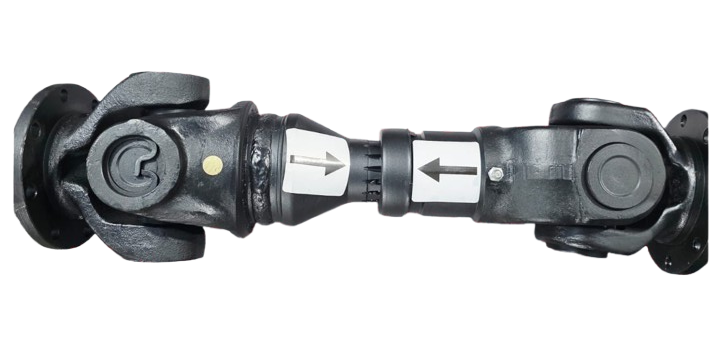
Propeller shaft, drive shaft and Cardan shaft nearly always refer to the same thing: the rotating tube that carries torque from the gearbox output to the differential input, with a universal joint at each end and usually a sliding splined section somewhere along its length.
The names differ by geography and by trade, not by engineering.
- Propeller shaft — British usage, and by inheritance the standard term across Indian commercial vehicles. Every CV workshop, parts counter and OEM manual in India will understand "prop shaft" to mean the gearbox-to-diff shaft and nothing else. It is the least ambiguous of the three in this market.
- Drive shaft — American usage for the same component. It is also used, in American and in modern general usage, for the short shafts that run from a differential out to the wheels. That second meaning is where the trouble starts.
- Cardan shaft — European and industrial usage, named after Gerolamo Cardano, the 16th-century Italian mathematician credited with describing the gimbal linkage the joint is based on. You will hear it from machinery builders, rolling mill engineers and European OEM documentation far more than from a truck workshop.
So when a distributor asks whether we make propeller shafts or Cardan shafts, the honest answer is: those are the same product line. The difference is who is asking.
Where the genuine confusion is: prop shaft vs axle half-shaft
This is the only distinction in the list that is mechanical rather than linguistic, and it is the one worth getting right.
The propeller shaft
It runs longitudinally, down the middle of the vehicle, under the floor. It connects the gearbox output flange to the differential pinion flange. It spins at engine/gearbox speed — far faster than the wheels — and it has to cope with the axle moving up and down on its springs while the gearbox stays bolted to the chassis. That is why it has universal joints at both ends and a splined slip section: the angle changes constantly and the effective length changes with it.
On longer wheelbases it becomes a two-piece or three-piece assembly with a centre bearing supporting the joint between sections, and on 6x4 tractors an inter-axle shaft carries drive from the first rear axle to the second.
The axle half-shaft
It runs transversely, inside the axle housing on a live axle, or out to each wheel hub on independent suspension. It connects the differential to the wheel. It spins at wheel speed, which on a loaded truck is a fraction of prop shaft speed, but it carries much higher torque because it sits after the final drive reduction.
Call both of them "drive shaft" and you are describing two parts that differ in length, speed, torque, joint type and mounting. In a supplier conversation that ambiguity costs a week.
What a Cardan joint actually is
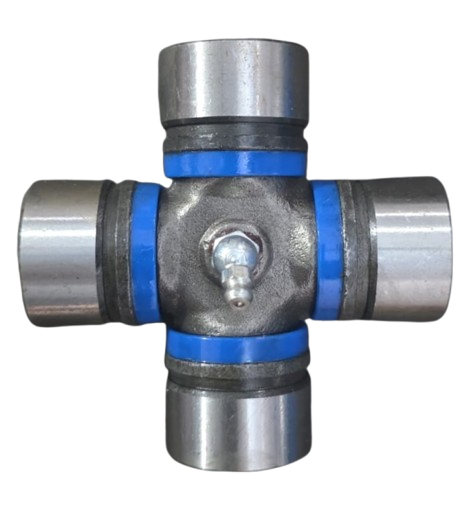
A Cardan joint — universal joint, Hooke's joint, U-joint, all the same thing — is a cross-shaped forging with four trunnions, held in two yokes at ninety degrees to each other. Each trunnion carries a needle-roller bearing cup. The arrangement lets torque pass through an angle while the two yokes pivot independently on perpendicular axes.
It has one important behaviour that anyone specifying a driveline needs to know: a single Cardan joint running at an angle does not deliver constant velocity. The output shaft speeds up and slows down twice per revolution, and the effect grows sharply with joint angle. A few degrees is barely noticeable. Fifteen degrees is a vibration you will feel in the cab.
This is why drivelines use joints in pairs and why phasing matters. When the two yokes at either end of a shaft are aligned in the same plane and the operating angles at each end are equal and opposite, the second joint cancels the speed variation introduced by the first. Get the phasing wrong during an overhaul — reassemble the slip yoke one spline out — and you have built a vibration into the shaft that no amount of balancing will remove. We cover the related failure modes in our guides on dynamic balancing and splined sleeve yokes.
A constant-velocity joint solves the same problem differently, with balls in curved races, and is why front-wheel-drive half-shafts use CV joints rather than Cardan joints. Cardan joints remain the standard on commercial vehicle propeller shafts because they are stronger, cheaper to service, and entirely adequate at the small angles a well-set-up truck driveline runs at.
The terminology, side by side
| Term | Where It Is Used | What It Refers To |
|---|---|---|
| Propeller Shaft | UK, India, CV trade | Gearbox to differential only — unambiguous |
| Drive Shaft | US, general usage | Prop shaft or axle half-shaft — ambiguous |
| Cardan Shaft | Europe, industrial, machinery | Any shaft using Cardan (universal) joints |
| Axle Half-Shaft | Everywhere | Differential to wheel hub — a different part |
What to ask for when you order
The term you use matters less than the five details that follow it. A supplier who has your dimensions can build the right shaft whatever you call it; a supplier who only has a name is guessing.
- Vehicle and variant. Make, model, wheelbase, axle configuration. A Tata Signa 4x2 and a Signa 6x4 do not share a driveline.
- Which shaft. Front section, rear section, inter-axle, or a single-piece. On a multi-piece assembly say which one.
- Flange-to-flange length, measured at the vehicle's normal ride height, and whether the slip joint was compressed or extended when you measured.
- Tube diameter and the joint series or cross dimensions — the cross diameter and the bearing cup centre-to-centre distance.
- End fittings. Flange yoke with bolt PCD and hole count, or a slip yoke with spline count. A photograph of each end is worth more than a paragraph.
If you are working from a part number rather than a vehicle, send that too. Fitment equivalent to Dana Spicer, RSB Global, Tata, Ashok Leyland, Eicher, BharatBenz, Mahindra, Volvo and JCB is what we build to, and a number resolves faster than a description ever will.
Not Sure Which Shaft You Need?
Send us a photograph of both ends and the flange-to-flange length. We will identify the shaft and confirm fitment before you commit to an order.
Industrial Cardan shafts are a different animal
Outside vehicles, the term Cardan shaft carries its own conventions. A shaft coupling a motor to a rolling mill stand, a pump drive, or a crusher runs at a fixed angle with no suspension movement, but often at far higher continuous torque and for thousands of hours without a stop. Those shafts are specified by torque rating and joint size rather than by vehicle fitment, and they are usually flanged at both ends rather than carrying a slip yoke.
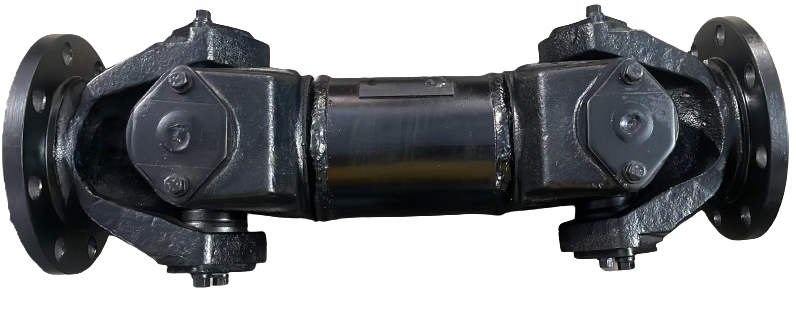
The engineering underneath is the same — forged crosses, needle bearings, balanced tube — which is why a driveline manufacturer builds both. What changes is the specification conversation. For machinery work, give us torque, speed, operating angle and centre distance, and we will work from there. The same applies to PTO drive shafts on agricultural and earthmoving equipment.
So which word should you use?
In India, with a commercial vehicle: say propeller shaft. It is what the workshops say, what the parts catalogues say, and it cannot be mistaken for an axle shaft.
Talking to a machinery OEM or a European supplier: Cardan shaft will be understood immediately and signals you mean the industrial product.
If you say drive shaft, add one clarifying word — "drive shaft, gearbox to diff" — and the ambiguity disappears. That single phrase saves more wasted enquiries than anything else in this article.
Whichever term you use, every shaft that leaves our two units at DSIDC Bawana is dynamically balanced 100% — not batch-sampled — and built under an ISO 9001:2015 system certified by TUV SUD Germany. You can see how that is done on our quality and infrastructure pages, or simply send us the details and we will tell you what you are looking at.