A driver comes in and says the truck "shakes at 60." That is usually the entire brief. No fault code, no leak, nothing broken that you can point at. And a driveline vibration is one of the few complaints where guessing is expensive — you can replace two universal joints, a centre bearing and the shaft itself and still hand back a vehicle that shakes exactly the same as when it arrived.
The good news is that driveline vibration is one of the most orderly diagnoses in the workshop, provided you ask the questions in the right sequence. What follows is the order a driveline shop works in, and the seven faults that account for the overwhelming majority of what actually walks through the gate.
First: Road Speed or Engine Speed?
Before you lift anything, settle this one question. It eliminates more wrong turns than any other test you can run, and it costs nothing but a short road run.
Get the vehicle to the speed where the vibration is worst. Note it. Now — with clear road ahead, and with a second person if you can — put the gearbox in neutral, or select a higher gear so the engine is turning noticeably slower at that same road speed.
- The vibration stays the same: it tracks road speed. The propeller shaft, wheels, tyres, hubs and brake drums all turn with road speed. Your problem is downstream of the gearbox output. This article is about that case.
- The vibration changes or disappears: it tracks engine speed. Look at the engine mounts, the clutch and pressure plate assembly, the fan and viscous drive, the harmonic damper, or a failing flywheel. The driveline is probably innocent.
Then separate the road-speed cases further. Tyre and wheel imbalance typically shows up as a low-frequency shake in a fairly narrow band — often around 80–100 km/h on a bus or truck on a highway run — and it usually rises and then eases off again as you pass through it. A propeller shaft turns several times faster than the wheels, so shaft-related vibration sits at a higher frequency: a buzz or drone through the floor and seat rather than a wallow through the steering wheel, and it tends to get steadily worse with speed rather than peaking and fading.
One more question worth asking the driver before you start: does it shake when the vehicle is loaded, or does it shake empty too? A load-dependent vibration points at geometry — the suspension sits down, the driveline angles change, and the fault appears. A vibration that is there empty and loaded alike is more likely balance, wear or damage.
Cause 1: Lost Balance Weight, Caked Mud and Underseal
Feels like: speed-dependent, present loaded or empty, and very often it appeared suddenly — one day fine, the next day shaking.
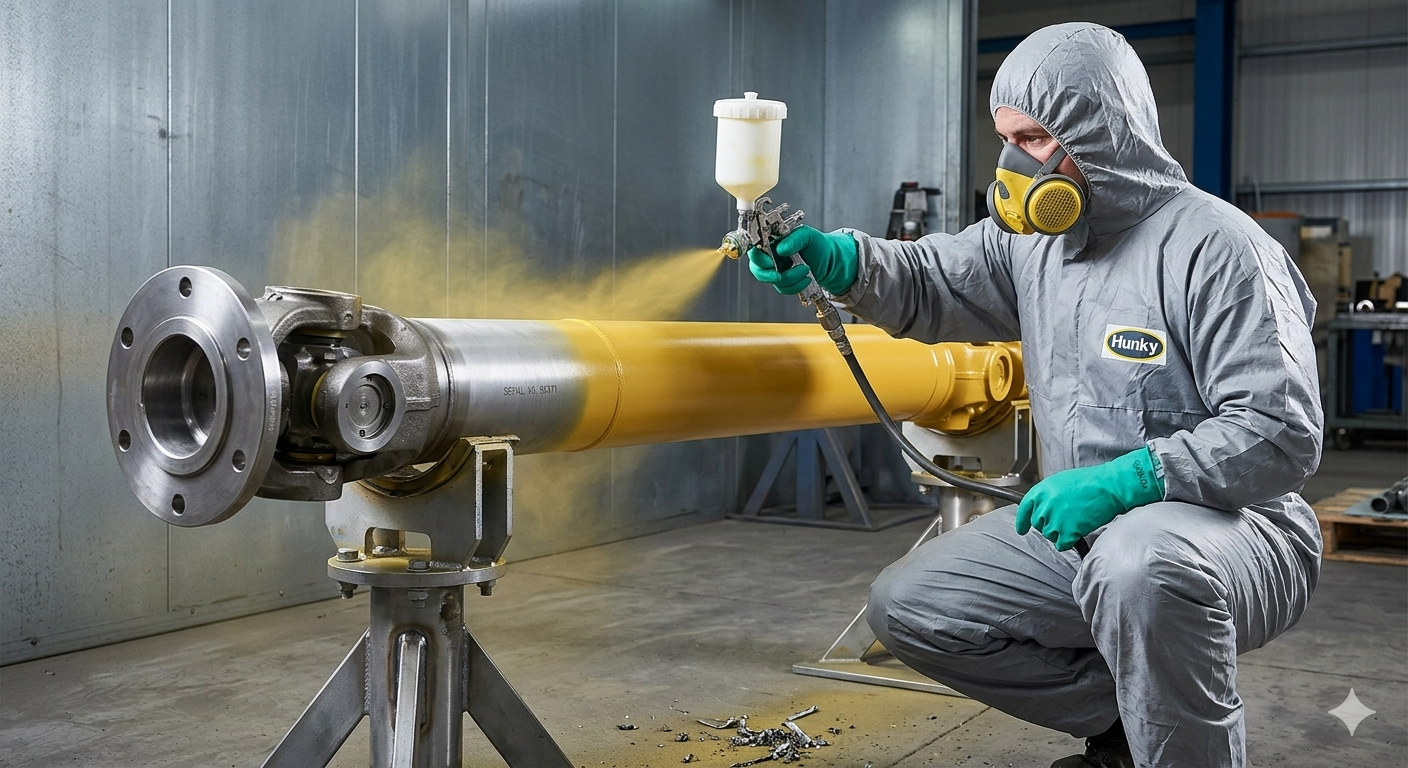
Every shaft we build leaves the plant 100% dynamically balanced, with small weights welded to the tube to cancel out residual imbalance. Those weights live on the underside of a vehicle. A stone thrown up on a bad haul road, or a scrape over a rock in a tipper's life, can knock one off. The moment it goes, the shaft is out of balance at every rotation.
The far more common version is dirt. A tipper working in clay, a mixer on a site, a shaft that has been sprayed with underseal by an enthusiastic bodyshop — any of these can build an uneven coating on the tube. It does not take much. Mass sitting off-centre on a component that spins at several thousand RPM generates a real, felt force, and that force grows with the square of the speed, which is exactly why a mild buzz at 40 km/h becomes an unbearable shake at 80.
How to confirm: clean the shaft properly — scraper, wire brush, degreaser, the whole length of the tube — and look for the bright weld scars where a balance weight used to be. Then road test. This is the cheapest test on the list and it fixes a surprising number of vehicles.
Repair or replace: if the tube is sound and only dirt was the problem, cleaning is the fix. If a weight is genuinely missing, the shaft needs rebalancing on a machine — do not guess weights by eye and tack them on. A shaft balanced by trial and error is a shaft that will come back.
Cause 2: Worn Universal Joints
Feels like: speed-dependent, usually accompanied by a clunk on take-up — engaging drive, or lifting off and going back on the throttle. A squeak at low speed that fades as you speed up is a dry joint calling for help.
A universal joint wears at the needle roller bearings running on the trunnions of the UJ cross. Once those bearings have play, the cross is no longer held on a fixed centre. It wanders, the shaft effectively becomes eccentric at that end, and you get vibration plus the classic clunk as the lash is taken up and released.
How to confirm: vehicle safely supported, handbrake off, gearbox in neutral. Grip the shaft on either side of the joint and try to twist the two halves against each other, then rock them. Any perceptible movement between yoke and cross is too much — a good joint feels dead solid. Check for the tell-tale rusty brown dust around a bearing cap; that is the powdered remains of a dry bearing and it means the joint has been running without grease. Look for a cap that has started to walk out of the yoke bore.
Repair or replace: a joint with play gets replaced, and on a two-joint shaft with equal service history, replace both. If a bearing cap has spun in its bore and worn the yoke oval, the yoke itself is finished — a new cross in a worn bore will be loose the week you fit it.
Cause 3: Perished Centre Bearing Rubber
Feels like: speed-dependent, often with a distinct low-speed rumble or growl from under the cab floor, and frequently worse under load or on take-off.
On a two-piece or three-piece shaft — most long-wheelbase trucks and buses — the centre bearing carries the intermediate shaft and is held in a rubber isolator inside its bracket. That rubber does two jobs: it locates the shaft, and it absorbs the small movements the driveline makes as the chassis flexes and the suspension works.
Heat, oil, ozone and years of load cycling harden and crack that rubber. Once it has collapsed on one side, the shaft is no longer running on the centre it was built and balanced around, and the whole assembly starts to whip. A dry or seized bearing adds a rumble on top.
How to confirm: push the shaft up, down and sideways at the bearing. A healthy mount gives a little and springs back. A dead one either does not move at all (rubber gone hard) or moves and stays there. Look for splits in the rubber and for the shaft sitting visibly off-centre in the bracket. Spin it by hand and listen for roughness in the bearing itself. Also check the bracket bolts into the crossmember — a loose bracket produces the same symptom.
Repair or replace: replace the bearing and its rubber as an assembly. Get the shaft alignment and any spacer shims back the way they were, because moving the centre bearing up or down changes your driveline angles — which brings us to the next cause.
Shaft Beyond Saving?
If the diagnosis lands on a bent tube, a worn yoke bore or a shaft that will not hold balance, we manufacture replacements to OEM fitment — forged alloy steel, CNC-machined, and every shaft dynamically balanced before it leaves the plant.
Cause 4: Wrong Driveline Angles After a Suspension or Bogie Change
Feels like: load-dependent and speed-dependent together. Often it appears right after work was done — new leaf springs, re-arched springs, a bogie rebuild, an axle swap, a lift or a chassis extension. Empty it may be tolerable; loaded it becomes obvious.
This one is the most misdiagnosed fault on the list, because nothing is worn and nothing is broken. A single Cardan-type universal joint does not transmit rotation smoothly when it is working at an angle — the output speeds up and slows down twice per revolution. The standard driveline cancels this out by using two joints whose angles are equal and opposite, so the second joint undoes what the first one did. Get those angles unequal and the cancellation stops working. The shaft now delivers a torsional pulse twice per revolution, and that is felt as a vibration that gets worse the harder the driveline is working.
How to confirm: measure. Put an angle finder or inclinometer on the gearbox output flange face, on the shaft tube, and on the pinion flange face, with the vehicle at its normal ride height and preferably at its normal working load. Compare the joint angles at each end against the manufacturer's figures. Check that the springs have not sagged unequally and that no shim has been left out of the pinion or gearbox mounting.
Repair or replace: this is corrected with shims and mounting position, not with new parts. Fitting a new shaft to a vehicle with bad angles achieves nothing except an invoice. If the geometry genuinely cannot be brought back, the answer may be a different shaft length or a different joint arrangement — talk it through with us on our engineering line before you buy anything.
Cause 5: Out-of-Phase Yokes on a Multi-Piece Shaft
Feels like: a persistent speed-dependent vibration that appeared immediately after a shaft was removed, rebuilt or reassembled, and that no amount of balancing will remove.
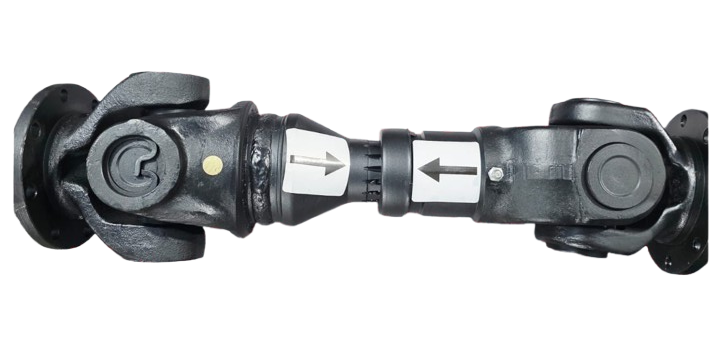
Related to Cause 4, and for the same underlying reason. On a shaft with a slip joint, the yokes at either end of the sliding section must be in the same plane as each other — in phase. That alignment is what allows the second joint's speed fluctuation to cancel the first one's. Pull a splined sleeve yoke apart for greasing, put it back one spline out, and you have built a permanent vibration into the vehicle.
How to confirm: sight along the shaft. The yoke ears at each end of the slip section should line up with each other. Most shafts carry a paint mark, an arrow or a missing master spline to make this unmistakable — look for it before you reassemble, not after.
Repair or replace: pull the slip joint apart and reassemble in phase. It is a twenty-minute job and it costs nothing.
Cause 6: A Bent, Dented or Deformed Tube
Feels like: speed-dependent, usually severe, and traceable to an event — grounding out on a rough site, a rock strike, a shaft that dropped and hit the road, or a recovery gone wrong.
A propeller shaft tube is a precision component with straightness held to a tight runout. It only takes a small bend or a significant dent for the shaft to be running with its mass off the rotational axis for its whole length, and no balance weight arrangement can properly compensate for a tube that is not straight.
How to confirm: mount a dial indicator against the tube and rotate the shaft slowly by hand, reading total indicated runout at several points along its length. Look for dents, for flat spots, and for cracks or lifted metal around the weld plug areas and the yoke welds.
Repair or replace: replace. A bent tube can sometimes be straightened, but a tube that has been bent once has been work-hardened at the bend, and on a heavy commercial vehicle a shaft that lets go at speed is not a risk worth taking to save the cost of a new one.
Cause 7: Worn Slip Yoke Splines, Loose or Uneven Flange Bolts
Two related faults, both of which come down to the shaft no longer being held concentric with what it bolts to.
Worn splines
Feels like: speed-dependent vibration plus a clunk when you take up drive or lift off, easily confused with a worn universal joint.
The splines in the slip yoke are supposed to slide freely in and out while holding the shaft dead central. Run them dry — a missed grease nipple, a failed dust boot letting grit in — and they wear. Once there is radial slop in the splines, the shaft can sit off-centre and will move around in service. Grip the shaft at the slip joint and try to rock it side to side; you are feeling for radial play, not the normal in-and-out sliding movement. Regular greasing is what prevents this, and our driveline maintenance guide sets out the schedule.
Loose or unevenly torqued flange bolts
Feels like: can be either — often a vibration that varies oddly, gets suddenly worse, and comes with a knock. Sometimes intermittent.
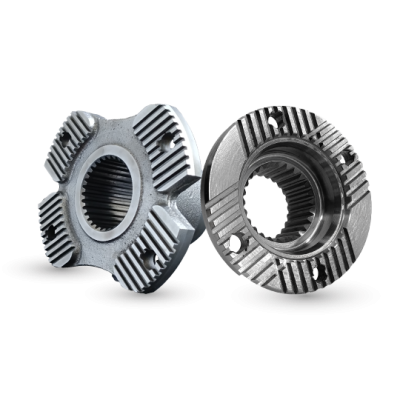
If even one flange bolt is loose, the joint face cannot seat properly, the shaft runs slightly cocked, and the remaining bolts carry a load they were never sized for. Bolts then come loose in sequence, which is why this fault tends to escalate quickly. Check for bright polished rub marks around the flange faces, for bolt holes that have elongated, and for missing or previously-replaced bolts. Retorque to specification with a torque wrench, evenly and in a cross pattern — never by feel. If a hole is elongated or a flange face is damaged, the flange or coupling needs replacing, not retorquing.
A Working Order of Diagnosis
Run it in this sequence and you will rarely waste a part.
| Symptom | Check This First | Not Usually This |
|---|---|---|
| Changes with engine RPM, not road speed | Engine mounts, clutch, fan drive | The propeller shaft |
| Appeared suddenly, no other change | Lost balance weight, mud on tube | Driveline angles |
| Only when loaded | Driveline angles, sagged springs | Shaft balance |
| Vibration plus a clunk on take-up | UJ play, slip splines, flange bolts | A bent tube |
| Started right after driveline work | Yoke phasing, angles, bolt torque | Component wear |
One last point worth making. A vibration is not only a comfort complaint — it is a load path. Every cycle of that shake is being fed into the gearbox output bearing, the pinion bearing, the centre bearing and the chassis mounts. A driver who tolerates a shake for six months rarely ends up paying only for a propeller shaft.
When the diagnosis does come back as a shaft, it is worth understanding what separates one that holds its balance from one that does not: straight tube, forged yokes, tight bore tolerances, and every single shaft balanced on a machine rather than sampled in batches. That is the standard we build to at our two units at DSIDC Bawana, and the reason we test every shaft rather than one in fifty.